
How Thermoset Tooling Is Different from Thermoplastic Tooling
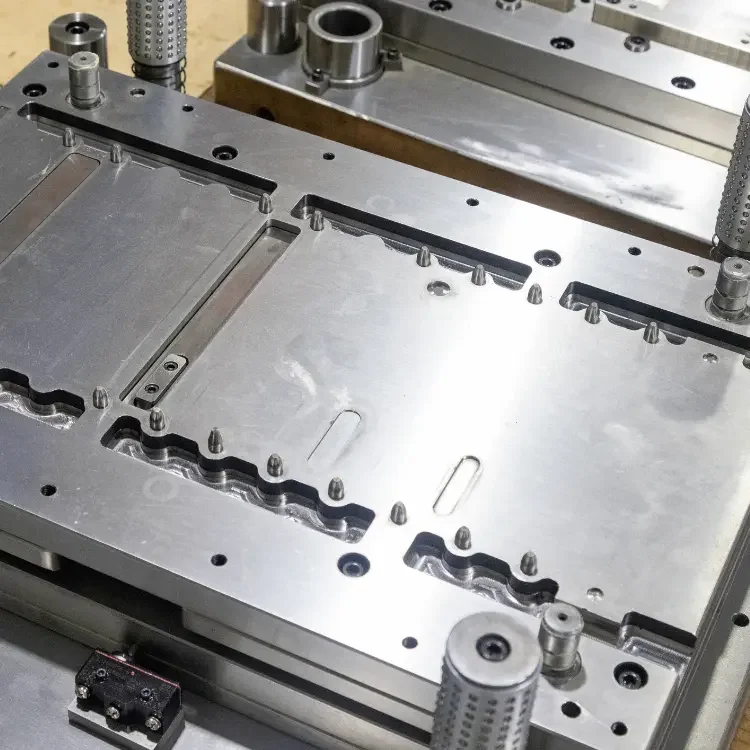
/At a quick glance, a mold is a mold. It's a hollowed-out block that's shaped in a specific way that will be filled with a type of liquid or pliable raw material to create final object.
Both thermoset and thermoplastic tooling must accurately form a component, withstand repeated production cycles, and consistently meet dimensional requirements.
But those similarities only go so far.
Thermoset and thermoplastic materials behave very differently during processing, and those differences directly affects how molds are designed and built. A thermoplastic is heated until it flows into the mold and then cooled until the part's rigid enough to eject. A thermoset undergoes an irreversible chemical curing reaction that permanently crosslinks the material.
For a precision mold manufacturer like Versatile Mold & Design, understanding those differences is essential. Temperature control, material flow, venting, steel selection, shrinkage, flash control, and even the basic mold architecture must be engineered around the material and molding process.
The Fundamental Difference: Cooling vs. Curing
The biggest distinction begins with what happens inside the mold.
In conventional thermoplastic injection molding, plastic pellets are heated until the material can flow. The molten polymer enters a comparatively cooler mold, fills and packs the cavity, and transfers heat into the tooling. Once the part has cooled sufficiently, the mold opens and the component is ejected.
The mold's thermal system is largely designed around removing heat efficiently and consistently.
Thermosets reverse much of that logic.
Thermoset compounds enter the mold before they're fully cured. Heat and pressure promote an irreversible chemical reaction that creates a crosslinked polymer network. Once cured, the material can't simply be melted and reshaped like a thermoplastic.
For thermoset tooling, the challenge becomes controlling heat to achieve consistent cure throughout the component. That fundamental difference influences nearly every tooling decision that follows.
Thermal Management Requires a Different Strategy
Cooling design is one of the most important aspects of thermoplastic injection tooling. Cooling circuits must remove heat efficiently while minimizing temperature differences throughout the cavity.
Poor cooling can contribute to longer cycle times, uneven shrinkage, warpage, and dimensional inconsistency.
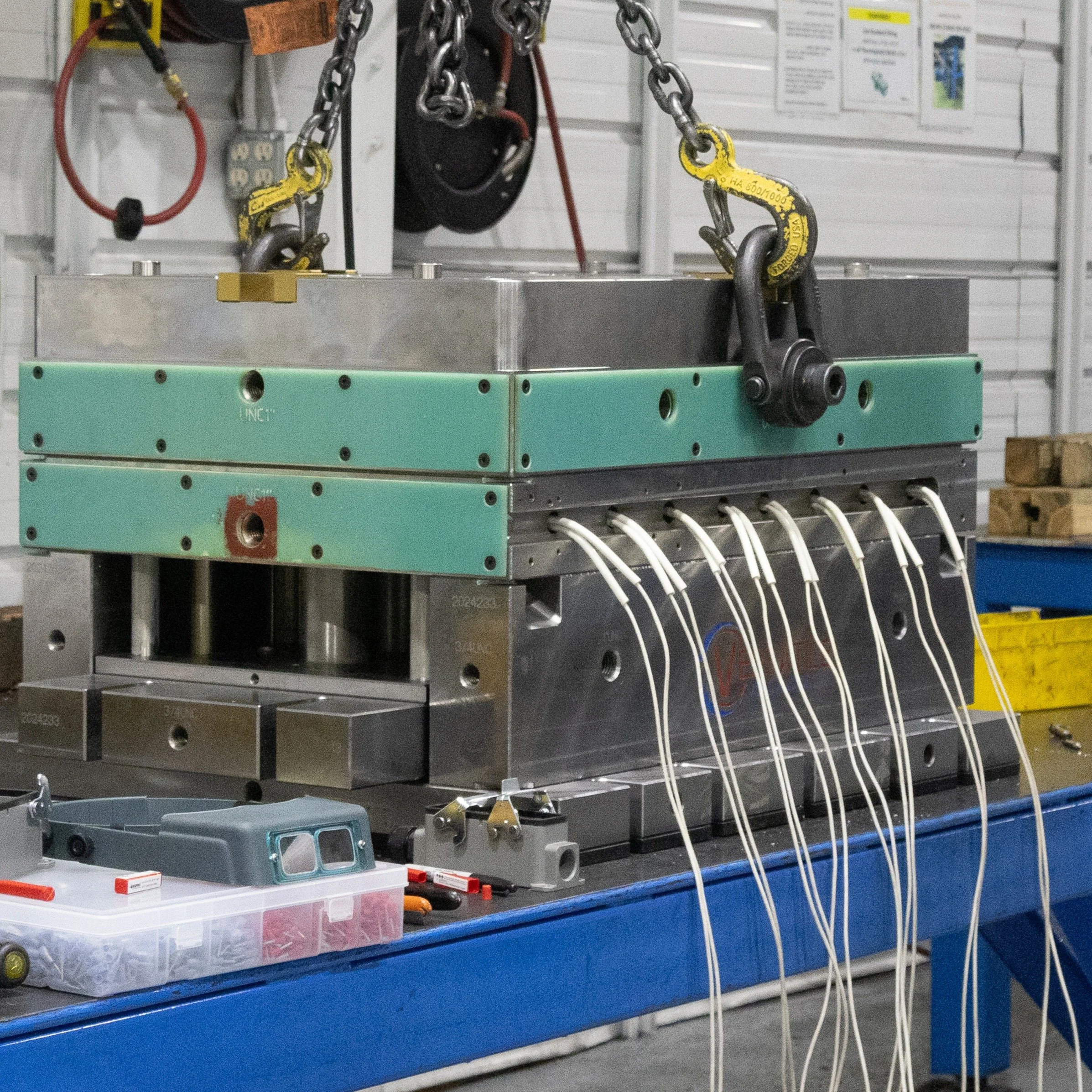
Thermoset tooling, by comparison, typically needs to maintain the temperaturs necessary to drive the curing reaction. Depending on the process, molds may use cartridge heaters, platens, oil systems, or other methods of thermal control.
Uniformity is especially important.
If one region of a thermoset mold operates significantly hotter or cooler than another, different areas of the component can develop different cure histories. Part thickness, tool geometry, heater placement, and the exothermic curing reaction itself can all influence those temperature gradients.
For the tool designer, thermal management is a fundamental part of the tooling architecture, not just an accessory.
Related Reading: Learn more about the engineering considerations involved in thermoset tooling in our article, Mastering the Art of Thermoset Mold Building.
Material Flow Changes the Mold Design
Thermoplastic injection molds typically use a defined material-delivery system consistent of a sprue, runners, and gates, or a hot-runner system. The tool designer must consider runner balance, gate type and location, shear, fill pattern, and packing.
Thermoset tooling introduces additional possibilities because thermosets can be processed through compression, transfer, or specialized injection molding.
In compression molding, a measured charge is placed directly into the open mold. As the mold closes, the material flows across the cavity before curing.
In transfer molding, material is placed in a pot and forced through passages into a closed cavity.
In thermoset injection molding, the compound is delivered through a system designed to fill the cavity while carefully managing temperature and cure progression.
As a result, there's no single thermoset tooling architecture. The tool must be engineered around the specific resin, reinforcement, geometry, and molding method.
Venting Takes on Greater Importance
Every molding process needs a way to remove trapped air, but venting is particularly important when processing thermosets. As material moves through the cavity and curing progresses, trapped air and process-related gases must be able to escape.
If they can't, manufacturers may encounter voids, burns, excessive flash, incomplete filling, and poor surface quality. Vents must be positioned where gases are likely to collect while being appropriately sized for the material being processed.
Thermoset mold design requires careful consideration of material flow, end-of-fill locations, cure behavior, and flash sensitivity when developing the venting strategy.
Flash Control Is a Major Thermoset Tooling Consideration
Parting-line quality matters for both thermoplastic and thermoset molds, but flash management can become an especially important part of compression mold design.
During compression molding, the charge is intentionally compressed as the mold closes. Material flows outward to fill the cavity, and excess material may move toward designated flash areas.
The mold must control where that excess material goes.
Tool designers need to consider parting surfaces, shutoffs, flash lands, overflow areas, and the method that will ultimately be used to deflash the component.
This is different from designing a thermoplastic injection mold primarily around containing pressurized molten resin within the cavity and runner system. In either case, precision at the parting line is critical, but the engineering objective is different.
Reinforcement Affects Tooling Decisions
Many thermoset molding compounds contain substantial amounts of glass fiber, mineral filler, or other reinforcement.
BMC (Bulk Molding Compound) and SMC (Sheet Molding Compound) are common examples.
These materials can provide excellent structural, thermal, dimensional, and electrical properties, but they also influence tooling.
Reinforcement can increase abrasive wear on mold surfaces and affect material flow. In compression molding, the initial charge's location and shape can also influence how fibers orient as material spreads through the cavity.
That makes charge placement part of the tooling and process-development strategy.
Highly reinforced thermoplastics create many of the same wear concerns, particularly glass-filled engineering resins. However, thermoplastic injection tooling must also account for the orientation created as reinforced material moves through runners, gates, and the cavity.
In both cases, the tool builder must understand the base polymer in addition to the complete compound being processed.
Tool Steel Selection Depends on the Processing Environment
There's no universal "thermoset steel" or "thermoplastic steel."
Steel selection should instead reflect the conditions the mold will experience. Engineers may evaluate a wide range of features, ranging from expected production volume and fiber and filler content all the way to mold size and expected service life.
An abrasive glass-filled material may justify hardened inserts or wear-resistant surfaces in high-contact areas. Other compounds may create different corrosion or temperature considerations.
Versatile can also design replaceable wear components into strategic locations, allowing maintenance teams to replace a smaller component rather than repair a more expensive section of the mold.
Tool life begins with understanding the production environment before steel is selected.
Related Reading: Tool steel selection is just one factor influencing mold longevity. Explore the additional design, maintenance, and manufacturing considerations in Why Some Molds Last Millions of Cycles While Others Wear Out Early.
Shrinkage and Dimensional Control Work Differently
Both thermoplastics and thermosets change dimensions during processing, but the mechanisms are different.
For thermoplastics, dimensional change is strongly influenced by cooling, crystallization where applicable, packing, pressure, material orientation, and thermal contraction.
Thermosets introduce another major variable: chemical shrinkage associated with crosslinking and cure.
Cure uniformity, reinforcement orientation, charge flow, thermal gradients, and post-cure conditions can influence the thermoset component's final dimensions.
This becomes particularly important for large, flat, thick, or tight-tolerance parts.
Tooling dimensions can't simply reproduce the nominal CAD geometry. The mold must be developed around how the selected material behaves during the actual process.
Part Release and Ejection Require Different Thinking
Thermoplastic injection molds commonly rely on ejector pins, sleeves, blades, stripper plates, slides, and lifters to release the cooled component. Those systems can become complex when a part includes deep geometry or undercuts.
Compression molded thermoset components may use different removal strategies depending on geometry and material. Draft, surface finish, shrinkage behavior, flash, and the cured component's rigidity all affect release.
Because thermosets cure into a rigid crosslinked structure, the designer can't rely on reheating or softening the finished component to solve a release problem.
Part removal needs to be engineered into the tool from the beginning.
Thermoset vs. Thermoplastic Tooling at a Glance
| Tooling Consideration | Thermoset Tooling | Thermoplastic Tooling |
|---|---|---|
| Material Transformation | Chemical cure and crosslinking | Melting followed by cooling/solidification |
| Primary Thermal Objective | Controlled heating and uniform cure | Efficient, uniform heat removal |
| Common Processes | Compression, transfer, and thermoset injection | Primarily injection molding |
| Material Delivery | Depends on process; may use direct change, transfer system, or injection | Typically sprue/runner/gate or hot runner |
| Venting | Critical for trapped air and process gases | Critical primarily for displaced air and gases |
| Flash Strategy | Major consideration, especially in compression molding | Controlled primarily through parting line and shutoffs |
| Reinforcement | BMC, SMC, and other highly filled compounds common | Filled and reinforced grades also common |
| Dimensional Behavior | Influenced by cure, thermal history, and reinforcement | Influenced by cooling, packing, shrinkage, and orientation |
| Tooling Focus | Heating, cure, venting, flow, and flash | Filling, packing, cooling, and ejection |
Why the Tool Builder Needs to Understand the Material
The difference between thermoset and thermoplastic tooling ultimately demonstrates a larger principle: precision mold building requires process knowledge.
A technically accurate cavity is only part of a successful production tool. The mold also needs to manage the material's physical and chemical behavior throughout every production cycle.
For thermoplastic tooling, that may mean optimizing runners, gates, cooling, venting, and ejection. For thermoset tooling, it may mean engineering heating, charge placement, cure uniformity, venting, flash control, and material flow.
Versatile Mold & Design provides complete design, build, and support services for precision molds and dies, allowing tooling decisions to be considered in the context of the complete production requirement.
With Versatile, manufacturers can evaluate the material, part geometry, molding process, tool design, expected volume, and maintenance requirements before those decisions are locked into steel.
Related Reading: See how material selection, engineering decisions, and precision tooling come together throughout the manufacturing process in From Conception to Production: The Mold Building Process.
Build the Right Tool for the Process
Thermoset and thermoplastic molds may ultimately service the same purpose, producing accurate, repeatable components, but they achieve that objective through very different processing conditions.
Understanding those differences is what turns a machined mold into a production-ready tool.
Whether your application requires a compression mold, transfer mold, thermoset injection mold, or thermoplastic injection mold, Versatile can help engineer tooling around the material and manufacturing process from the beginning.
Talk with Versatile about your next precision mold build and develop a tooling strategy designed for reliable, repeatable production.